

Creating a redirect: domain, paths, DNS, and SSL
Set up a SiteDetour redirect end-to-end: create the record, configure path rules, point DNS, and acquire an SSL certificate.
Overview
A SiteDetour redirect maps incoming requests from a source domain (or subdomain) to one or more target URLs, evaluated by a set of path rules. This article walks through the end-to-end setup: creating the redirect record, pointing DNS, and acquiring an SSL certificate.
Before you start
You'll need:
- A domain or subdomain you control and can modify DNS records for.
- A SiteDetour plan with available redirect capacity (see Billing).
- The destination URL(s) you want to redirect to.
Step 1: create the redirect record
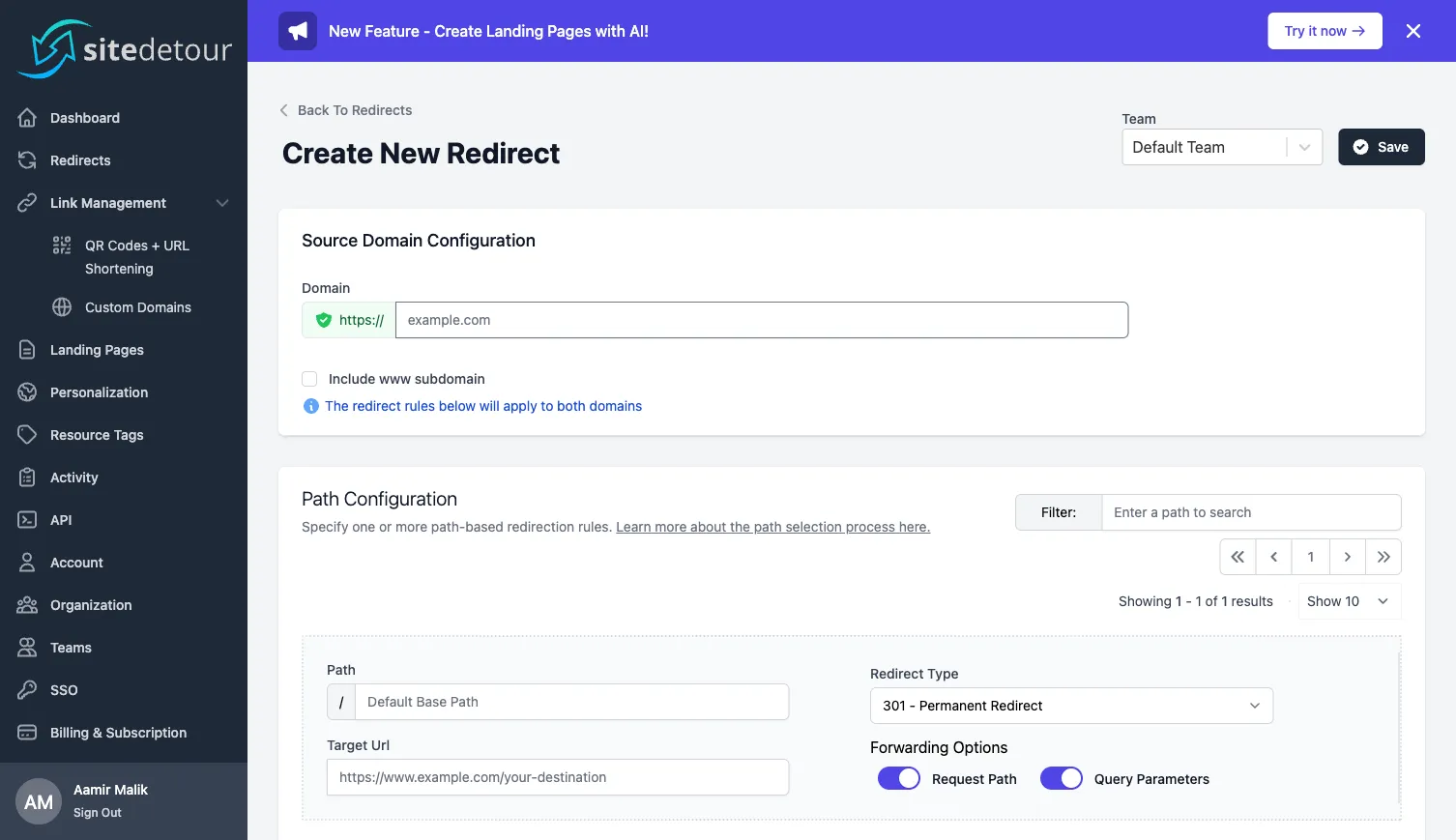
Log in and navigate to Redirects. Click Create New to open the editor.
Source Domain Configuration
Enter the source domain in the Domain field — the hostname you want to redirect from. Examples: example.com, docs.example.com.
Check Include www subdomain if you want to serve the same rules on both example.com and www.example.com. You don't need to create two records.
Path Configuration
The path table starts with a Default Base Path (path /) which is the fall-through rule used when no more-specific path matches. For each path entry:
- Path — the source path to match, relative to the domain.
- Redirect Type — HTTP status code. Options include 301 (Permanent), 302 (Found/Temporary), and 307 (Temporary preserving method).
- Target Url — the destination URL.
- Forwarding Options:
- Request Path — append the incoming request's path to the target URL (e.g.
/foo?x=1→target.com/foo). - Query Parameters — preserve the query string on the redirect.
- Request Path — append the incoming request's path to the target URL (e.g.
Add more paths with the + button. SiteDetour's path selection algorithm always picks the longest matching path, falling back to the default. See the path selection algorithm for details.
Click Save at the top right. The redirect record is now created, but DNS and SSL still need to be configured before traffic will flow.
Step 2: point DNS at SiteDetour
On the redirect editor you will see two status indicators near the heading: DNS Not Pointed and HTTPS Not Enabled. Click View DNS Instructions to open the DNS panel.
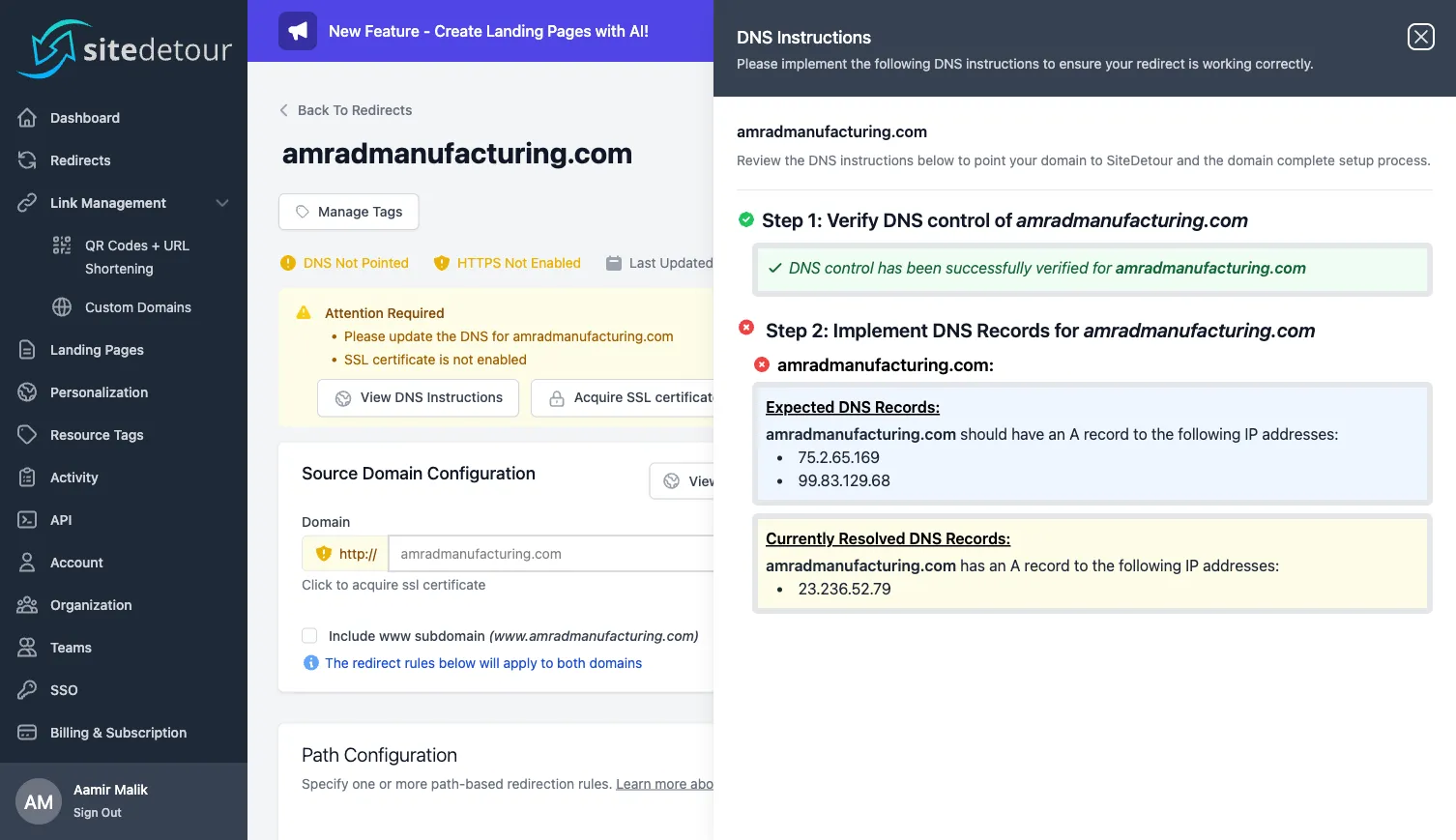
The panel shows:
- Step 1: Verify DNS control — SiteDetour needs to confirm you control the domain before it will issue a certificate.
- Step 2: Implement DNS Records — the exact records to add, based on whether your source is a naked domain or a subdomain:
- Naked / apex domain — add the A records displayed in the panel.
- Subdomain — add a CNAME pointing at the hostname displayed in the panel.
Always use the values shown in the DNS Instructions panel — they are the authoritative source for your account.
The panel also displays Currently Resolved DNS Records, which is what SiteDetour sees at the moment. Once your DNS records propagate and match the expected values, the status indicator flips to DNS Pointed.
Propagation is typically under 5 minutes for subdomain CNAMEs and up to 24 hours for apex records, depending on TTLs.
Step 3: acquire an SSL certificate
Once DNS is pointed, click Acquire SSL certificate. SiteDetour issues a certificate for the source domain via automated domain validation. No action is required on your side beyond waiting for the request to complete.
Certificates auto-renew well before expiration. If a renewal fails, the redirect is marked with an HTTPS Not Enabled warning; contact support or re-trigger acquisition.
Step 4: (optional) advanced settings
Click Advanced Settings to open the options panel:
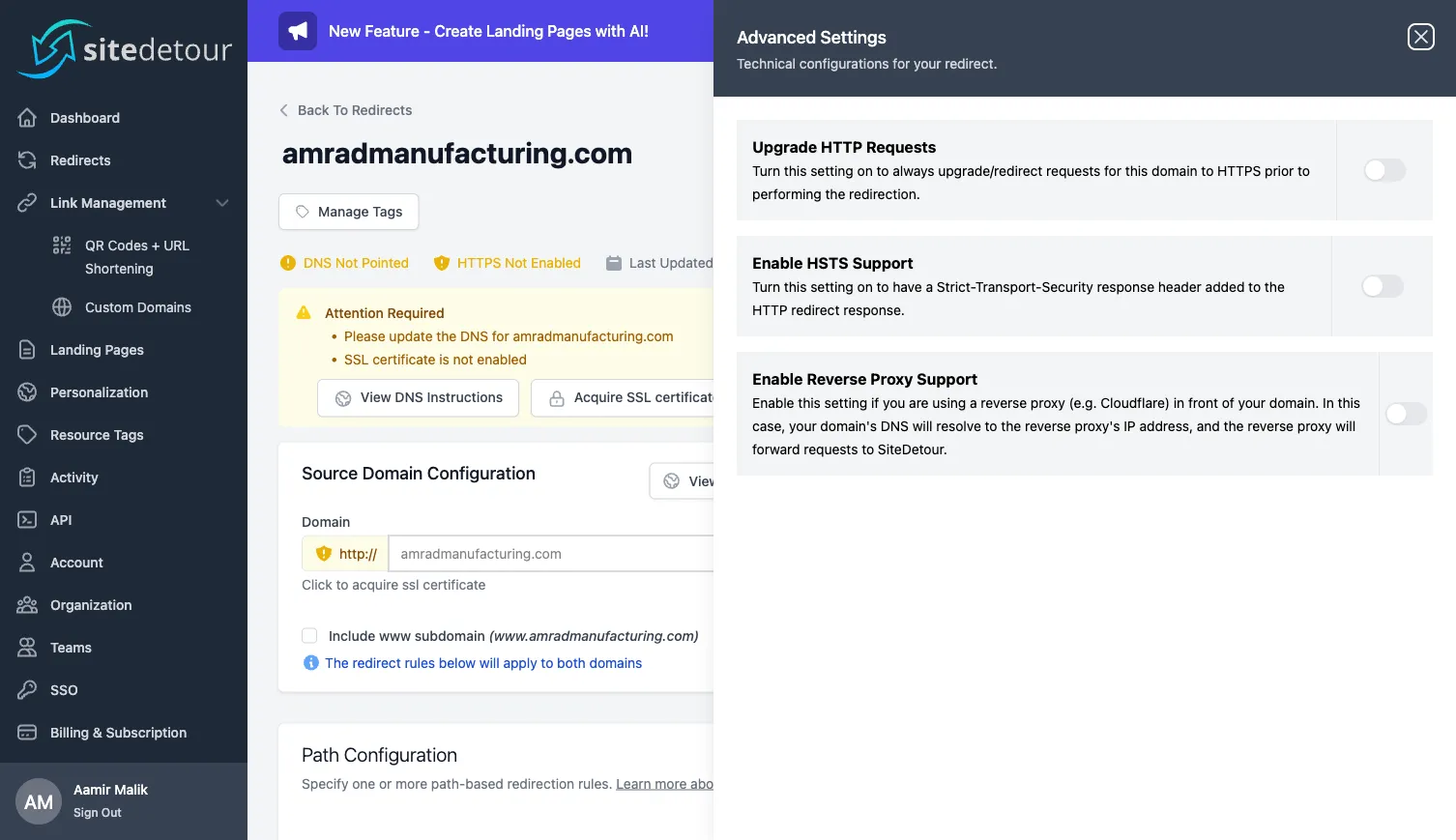
- Upgrade HTTP Requests — force HTTP to 302 to HTTPS before running the redirect. Useful when the target does not itself upgrade. See Upgrade HTTP Requests.
- Enable HSTS Support — add
Strict-Transport-Securityto the response. Tells browsers to auto-upgrade HTTP for your domain on subsequent visits. - Enable Reverse Proxy Support — if you operate your DNS behind Cloudflare or similar, toggle this on so SiteDetour reads the real client IP from
X-Forwarded-For.
Verifying the redirect
Once DNS is pointed and SSL is issued, request https://{source-domain}/ from a browser or curl -I. You should see a 301/302 response with a Location header pointing at your configured target.
Use the public URL Redirect Checker to inspect the full redirect chain end-to-end.
Troubleshooting
- DNS Not Pointed status persists. The panel shows Currently Resolved vs. Expected — verify your DNS provider applied the new records and TTLs have expired. Use
dig +short example.comordig example.com Afrom the command line. - SSL acquisition fails. SSL validation requires DNS to be pointing at SiteDetour first. Fix DNS, then retry.
- Redirects don't fire. Clear browser cache (301s are aggressively cached) or test in a private window.
Next steps
